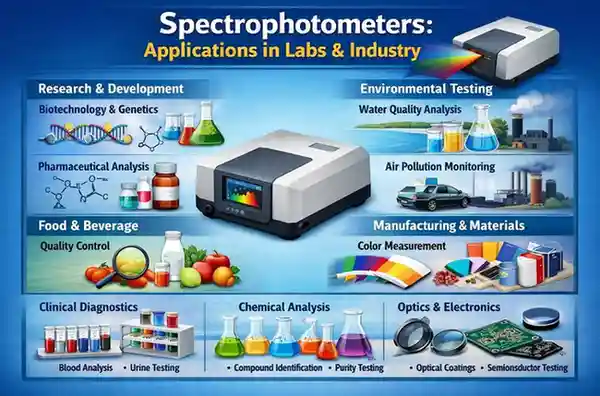
Spectrophotometers: Applications in Labs & Industry
Spectrophotometers: Applications in Labs & Industry
Spectrophotometers are among the most essential analytical instruments used across laboratories and industrial sectors. From pharmaceutical quality testing to environmental monitoring and chemical analysis, these advanced devices play a critical role in ensuring accuracy, compliance, and efficiency.
In today’s data-driven and compliance-focused environment, businesses are investing heavily in laboratory testing equipment such as spectrophotometers to improve reliability and reduce costly errors.
This comprehensive guide covers everything you need to know about spectrophotometers, including their types, applications, pricing, benefits, ROI, and future trends.
What is a Spectrophotometer?
A spectrophotometer is a scientific instrument used to measure the intensity of light absorbed or transmitted by a sample. It helps determine the concentration of substances in a solution by analyzing how much light is absorbed at specific wavelengths.
This technology is widely used in chemical analysis tools and research laboratories for precise quantitative and qualitative measurements.
How Spectrophotometers Work
Spectrophotometers operate based on the principle of light absorption. The process involves:
- Light source emitting specific wavelengths
- Sample interaction with light
- Detector measuring transmitted or absorbed light
- Data processing to determine concentration
The results are typically displayed as absorbance or transmittance values, which are used for analysis.
Types of Spectrophotometers
1. UV-Visible Spectrophotometers
Used for analyzing samples in ultraviolet and visible light ranges. Common in pharmaceutical and chemical industries.
2. Infrared (IR) Spectrophotometers
Used for identifying molecular structures and chemical bonds.
3. Fluorescence Spectrophotometers
Measure emitted light from excited samples, ideal for biological and medical research.
4. Atomic Absorption Spectrophotometers
Used for detecting metal concentrations in samples.
5. Portable Spectrophotometers
Compact devices for on-site testing and field analysis.
Applications of Spectrophotometers
Pharmaceutical Industry
Used for drug formulation, quality control, and compliance testing.
Chemical Industry
Essential for analyzing chemical compositions and reactions.
Environmental Testing
Helps monitor water quality and detect pollutants.
Food and Beverage Industry
Used for quality assurance and contamination detection.
Research Laboratories
Supports advanced scientific studies and experiments.
Cost of Spectrophotometers in 2026
The spectrophotometer price depends on type, accuracy, and automation level.
| Type | Price Range (USD) | Application |
|---|---|---|
| Portable Spectrophotometer | $2,000 - $10,000 | Field testing |
| UV-Vis Spectrophotometer | $5,000 - $25,000 | General lab analysis |
| Advanced IR Systems | $20,000 - $80,000 | Chemical identification |
| High-End Automated Systems | $80,000 - $200,000+ | Industrial labs |
Key Benefits of Spectrophotometers
1. High Accuracy and Precision
Provides reliable and repeatable results essential for quality control.
2. Fast Analysis
Delivers quick results, improving productivity in labs.
3. Versatility
Applicable across multiple industries and testing scenarios.
4. Compliance Support
Ensures adherence to regulatory standards such as FDA and ISO.
5. Cost Efficiency
Reduces material waste and testing errors.
Comparison of Spectrophotometer Types
| Parameter | UV-Vis | IR | Fluorescence |
|---|---|---|---|
| Accuracy | High | Very High | Extremely High |
| Speed | Fast | Moderate | Fast |
| Cost | Moderate | High | High |
ROI of Spectrophotometer Investment
Investing in advanced analytical instruments offers strong ROI through improved accuracy and efficiency.
| Metric | Before | After |
|---|---|---|
| Error Rate | 10% | 2% |
| Testing Time | Long | Reduced |
| Operational Cost | High | Optimized |
Integration with Modern Laboratory Systems
Modern spectrophotometers integrate with digital systems for enhanced performance:
- Cloud-based data storage
- AI-driven analysis
- Automated reporting
- IoT-enabled monitoring
Challenges and Solutions
High Initial Cost
Solution: Focus on long-term ROI and efficiency improvements.
Maintenance Requirements
Solution: Use predictive maintenance systems.
Training Needs
Solution: Provide staff training and certification programs.
Future Trends in Spectrophotometry
- AI-powered analysis tools
- Portable and handheld devices
- Automation in testing processes
- Integration with smart labs
How to Choose the Right Spectrophotometer
- Identify application requirements
- Evaluate accuracy and wavelength range
- Consider automation features
- Analyze total cost of ownership
Expert Tips:
- Choose reliable brands and suppliers
- Invest in scalable systems
- Ensure compliance with industry standards
Conclusion
Spectrophotometers are indispensable tools in modern laboratories and industrial environments. Their ability to deliver accurate, fast, and reliable results makes them a cornerstone of laboratory testing equipment worldwide.
By investing in advanced spectrophotometers, organizations can enhance productivity, ensure compliance, and achieve long-term cost savings.
Ready to upgrade your laboratory capabilities? Choose the right spectrophotometer and take your analytical performance to the next level.