Quality Control Using Spectrophotometers Explained
Quality Control Using Spectrophotometers Explained
In modern manufacturing and laboratory environments, maintaining precise quality standards is critical for ensuring product consistency, safety, and regulatory compliance. One of the most essential quality control instruments used across industries is the spectrophotometer.
From pharmaceuticals and chemicals to food processing and environmental testing, spectrophotometer applications play a vital role in analyzing materials, detecting impurities, and ensuring that products meet strict quality benchmarks.
This comprehensive guide explores how spectrophotometers work, their industrial applications, cost considerations, and how they significantly improve industrial QA systems and manufacturing efficiency.
What is a Spectrophotometer?
A spectrophotometer is an analytical instrument used to measure the intensity of light absorbed by a substance at different wavelengths. This measurement helps determine the concentration and composition of a sample.
It is widely used in laboratories and industrial environments as part of lab testing tools for chemical analysis, quality assurance, and research.
How Spectrophotometers Work
The working principle of a spectrophotometer is based on light absorption. When light passes through a sample, certain wavelengths are absorbed while others pass through. The instrument measures this absorption to analyze the sample.
- Light source emits specific wavelengths
- Sample absorbs part of the light
- Detector measures transmitted light
- Software calculates concentration levels
Importance of Quality Control in Industry
Quality control is essential for maintaining product standards and avoiding costly errors. Without proper inspection systems, businesses may face:
- Product defects and recalls
- Regulatory non-compliance
- Customer dissatisfaction
- Financial losses
Using advanced measurement devices like spectrophotometers helps industries ensure accuracy and consistency.
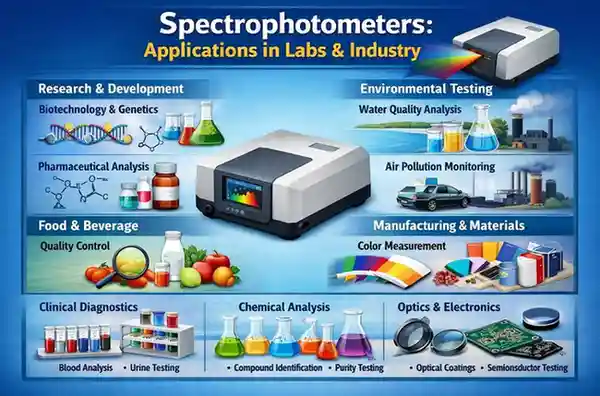
Key Applications of Spectrophotometers
1. Pharmaceutical Industry
Used for drug formulation, purity testing, and compliance with regulatory standards.
2. Chemical Industry
Helps analyze chemical compositions and detect contaminants.
3. Food & Beverage Industry
Ensures product quality, color consistency, and ingredient accuracy.
4. Environmental Testing
Used for water and air quality monitoring.
5. Research Laboratories
Essential for scientific studies and material analysis.
Types of Spectrophotometers
UV-Vis Spectrophotometers
Used for measuring ultraviolet and visible light absorption.
Infrared (IR) Spectrophotometers
Analyze molecular structures using infrared radiation.
Fluorescence Spectrophotometers
Measure emitted light from excited samples.
Cost of Spectrophotometers in 2026
The cost of spectrophotometers depends on features, accuracy, and automation capabilities.
| Type | Price Range (USD) | Application |
|---|---|---|
| Basic UV-Vis | $2,000 - $10,000 | Educational & small labs |
| Advanced UV-Vis | $10,000 - $50,000 | Industrial testing |
| High-End Analytical Systems | $50,000 - $150,000+ | Pharma & research |
Benefits of Using Spectrophotometers for Quality Control
1. High Accuracy and Precision
Ensures reliable measurement results for critical applications.
2. Defect Detection
Identifies impurities and inconsistencies early in production.
3. Improved Efficiency
Automated analysis reduces manual errors and speeds up processes.
4. Regulatory Compliance
Supports adherence to global quality standards.
5. Cost Savings
Reduces waste, rework, and production downtime.
Comparison of Spectrophotometer Types
| Feature | UV-Vis | IR | Fluorescence |
|---|---|---|---|
| Accuracy | High | Very High | Extremely High |
| Cost | Moderate | High | Very High |
| Applications | General testing | Chemical analysis | Advanced research |
Industries That Rely on Spectrophotometers
- Pharmaceutical manufacturing
- Biotechnology and research labs
- Chemical production
- Food and beverage processing
- Environmental monitoring agencies
ROI of Spectrophotometer Investment
Investing in advanced analytical equipment delivers measurable ROI through improved efficiency and reduced defects.
| Metric | Before | After |
|---|---|---|
| Defect Rate | 10% | 2% |
| Testing Time | High | Reduced |
| Operational Cost | High | Optimized |
Integration with Smart Manufacturing
Modern spectrophotometers integrate with digital systems to enhance quality control processes:
- AI-powered analysis
- Cloud-based data storage
- Real-time monitoring
- Automated reporting systems
Future Trends in Spectrophotometry
- Miniaturized portable devices
- AI-driven diagnostics
- Advanced multi-wavelength systems
- Integration with IoT platforms
How to Choose the Right Spectrophotometer
- Determine application requirements
- Evaluate wavelength range
- Check automation features
- Consider long-term maintenance costs
Expert Tips:
- Invest in scalable systems
- Choose trusted suppliers
- Ensure compliance with industry standards
Conclusion
Spectrophotometers are essential tools for ensuring quality control in both industrial and laboratory environments. Their ability to deliver precise, reliable data makes them indispensable for modern manufacturing processes.
By integrating advanced industrial QA systems and leveraging spectrophotometer technology, businesses can reduce defects, improve efficiency, and achieve long-term growth.
Looking to upgrade your quality control systems? Investing in advanced spectrophotometers can significantly enhance your operational performance and profitability.