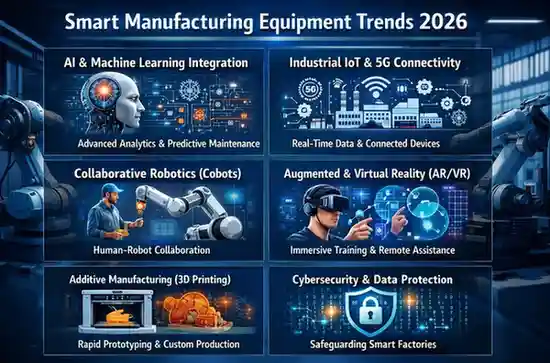
Smart Manufacturing Equipment Trends 2026
Smart Manufacturing Equipment Trends 2026
As industries embrace Industry 4.0, smart manufacturing equipment is transforming production floors worldwide. The year 2026 marks a period of accelerated adoption of advanced automation, IoT-enabled machines, and AI-driven analytics in factories. These trends are driving efficiency, cost savings, and increased business revenue. In this comprehensive guide, we explore the latest smart manufacturing equipment trends for 2026 and how they shape the future of industrial operations.
1. IoT-Enabled Smart Equipment
Internet of Things (IoT) sensors embedded in machinery provide real-time data on performance, energy consumption, and predictive maintenance. Manufacturers leverage this data to reduce downtime, optimize workflows, and extend equipment life.
- Real-time monitoring of machine health
- Predictive maintenance alerts
- Integration with central management dashboards
2. AI and Machine Learning in Production
AI algorithms analyze operational data to optimize production schedules, detect anomalies, and predict demand trends. Machine learning enhances precision in quality control and reduces defects, directly improving ROI.
- Automated defect detection in assembly lines
- Optimized supply chain and inventory management
- Adaptive production strategies based on historical data
3. Collaborative Robotics (Cobots)
Cobots work alongside human operators to handle repetitive or dangerous tasks, enhancing safety and efficiency. These robots are flexible, scalable, and easy to program, making them ideal for dynamic manufacturing environments.
4. Advanced Automation Systems
Automation systems are becoming more intelligent, connecting machines, sensors, and software for seamless operations. This leads to faster cycle times, lower operational costs, and consistent product quality.
5. Energy-Efficient Manufacturing Equipment
Energy consumption is a major operational expense. Smart equipment with energy optimization features reduces electricity costs while supporting sustainability goals.
6. Digital Twins and Simulation Tools
Digital twin technology creates virtual replicas of manufacturing plants, allowing simulations for production planning, layout optimization, and predictive maintenance. Companies can experiment with process improvements without disrupting actual operations.
7. Additive Manufacturing & 3D Printing Integration
3D printing and additive manufacturing are increasingly integrated into production lines for rapid prototyping, customized products, and low-volume high-complexity parts.
8. Cloud-Connected Manufacturing Systems
Cloud connectivity allows remote monitoring and control of factory operations. Data from multiple sites can be centralized for analytics, facilitating decision-making and enhancing operational transparency.
Cost vs ROI Analysis of Smart Equipment
| Equipment Type | Cost Factors | ROI Benefits |
|---|---|---|
| IoT Sensors & Smart Machines | Installation, software integration, maintenance | Reduced downtime, predictive maintenance savings |
| Collaborative Robots (Cobots) | Initial purchase, programming, safety integration | Labor cost reduction, improved throughput |
| AI & Machine Learning Systems | Software licenses, data infrastructure, training | Optimized production, lower defect rates, higher quality |
| Energy-Efficient Equipment | Higher upfront cost for green technologies | Lower energy bills, sustainability compliance benefits |
| 3D Printing & Additive Manufacturing | Machine cost, materials, maintenance | Rapid prototyping, reduced inventory, customization capability |
Maximizing ROI from Smart Manufacturing Equipment
To maximize returns, manufacturers should:
- Invest in scalable and modular equipment
- Integrate IoT and AI analytics for predictive insights
- Train staff to leverage automation effectively
- Monitor energy usage and optimize for sustainability
- Continuously review process efficiency and adapt technologies
Conclusion
The 2026 landscape of smart manufacturing emphasizes data-driven, connected, and energy-efficient equipment. By adopting trends such as IoT-enabled machines, AI analytics, collaborative robots, and digital twins, companies can achieve operational excellence, reduce costs, and significantly increase profitability. Staying ahead of these trends is essential for manufacturers seeking a competitive advantage in the Industry 4.0 era.