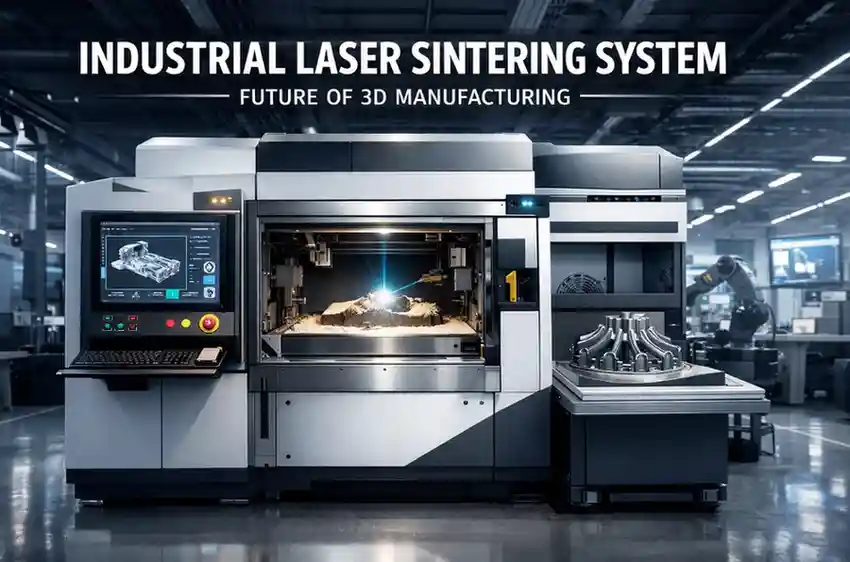
Industrial Laser Sintering System: Future of 3D Manufacturing
Industrial Laser Sintering System: Future of 3D Manufacturing
The global manufacturing landscape is rapidly evolving with the adoption of advanced digital technologies. Among the most transformative innovations is the industrial laser sintering system, a core component of modern additive manufacturing. This technology is redefining how products are designed, prototyped, and produced at scale.
From aerospace to healthcare and automotive sectors, SLS technology is enabling faster production cycles, reduced costs, and unmatched design flexibility. In this comprehensive guide, we explore how 3D printing industrial machines powered by laser sintering are shaping the future of manufacturing.
What is an Industrial Laser Sintering System?
An industrial laser sintering system is a high-performance 3D printing technology that uses a powerful laser to fuse powdered materials layer by layer. This process creates durable, complex, and highly precise components without the need for traditional tooling.
This makes it one of the most efficient rapid prototyping tools and production solutions available in modern industry.
How SLS Technology Works
The Selective Laser Sintering (SLS) process follows a precise and automated workflow:
- A thin layer of powdered material is evenly spread across the build platform
- A high-powered laser selectively fuses the powder based on CAD design data
- The platform lowers, and a new layer is applied
- The process repeats until the final 3D object is completed
This layer-by-layer manufacturing approach allows for exceptional detail and minimal material waste.
Why Laser Sintering is the Future of Manufacturing
1. Design Freedom & Complexity
SLS enables manufacturers to create complex geometries that are impossible with traditional machining or molding processes.
2. Tool-Free Production
No molds or dies are required, significantly reducing upfront costs and lead times.
3. Rapid Prototyping
Engineers can quickly iterate designs, test prototypes, and bring products to market faster.
4. Mass Customization
Each product can be customized without increasing production costs.
5. Reduced Material Waste
Unused powder can often be recycled, improving sustainability and cost efficiency.
Industrial Applications of Laser Sintering Systems
Aerospace Industry
Used for manufacturing lightweight and high-strength components with complex geometries.
Automotive Industry
Enables rapid prototyping, tooling, and production of performance parts.
Healthcare & Medical Devices
Ideal for custom implants, prosthetics, and surgical tools.
Consumer Electronics
Supports miniaturized and highly precise components.
Industrial Equipment Manufacturing
Used for producing durable and customized machine parts.
Additive Manufacturing Cost Analysis
The additive manufacturing cost varies depending on machine capability, material type, and production volume.
| Cost Factor | Traditional Manufacturing | SLS Manufacturing |
|---|---|---|
| Tooling Cost | High | None |
| Material Waste | High | Low |
| Production Flexibility | Low | Very High |
| Lead Time | Weeks | Days |
Industrial 3D Printing Machine Price in 2026
The cost of laser sintering systems depends on size, automation, and material compatibility.
| Machine Category | Price Range (USD) | Best Use Case |
|---|---|---|
| Entry-Level SLS Systems | $50,000 - $150,000 | Prototyping |
| Mid-Range Industrial Systems | $150,000 - $500,000 | Small batch production |
| High-End Industrial Systems | $500,000 - $2M+ | Mass production |
Key Benefits of Industrial Laser Sintering Systems
- High precision and repeatability
- Faster product development cycles
- Reduced operational costs
- Scalable production capabilities
- Enhanced design innovation
Comparison: SLS vs Traditional Manufacturing
| Parameter | SLS Technology | Traditional Manufacturing |
|---|---|---|
| Customization | Easy | Limited |
| Setup Time | Low | High |
| Complex Designs | Supported | Restricted |
ROI of Laser Sintering Systems
Investing in industrial 3D printing systems delivers strong ROI by reducing production costs and accelerating time-to-market.
| Metric | Before SLS | After SLS |
|---|---|---|
| Product Development Time | 6-8 Weeks | 1-2 Weeks |
| Production Cost | High | Reduced by 30-50% |
| Design Flexibility | Limited | Unlimited |
Integration with Smart Manufacturing
Modern additive manufacturing solutions integrate seamlessly with Industry 4.0 technologies:
- IoT-enabled monitoring systems
- Cloud-based production management
- AI-driven design optimization
- Automated production workflows
Future Trends in 3D Manufacturing
- Multi-material 3D printing systems
- AI-powered generative design
- Fully automated smart factories
- Sustainable and recyclable materials
How to Choose the Right Laser Sintering System
- Evaluate production volume and requirements
- Consider material compatibility
- Analyze total cost of ownership
- Check software and automation capabilities
Expert Tips
- Start with scalable mid-range systems
- Focus on long-term ROI rather than upfront cost
- Invest in operator training and maintenance
Conclusion
The industrial laser sintering system is at the forefront of the manufacturing revolution. By enabling rapid prototyping, reducing waste, and supporting complex designs, it offers unmatched advantages over traditional methods.
Businesses that adopt 3D printing industrial machines and additive manufacturing solutions will gain a strong competitive edge in global markets.
Ready to future-proof your manufacturing process? Investing in laser sintering technology is a strategic move toward innovation, efficiency, and long-term growth.