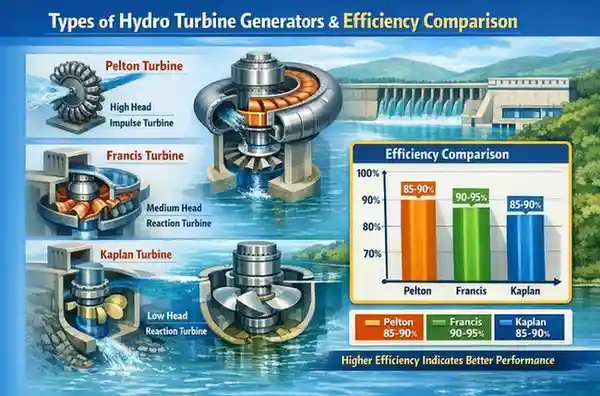
Types of Hydro Turbine Generators & Efficiency Comparison
Types of Hydro Turbine Generators & Efficiency Comparison
Hydropower remains one of the most efficient and reliable renewable energy sources globally. However, selecting the right hydro turbine generator is critical to maximizing energy output, reducing operational costs, and achieving long-term ROI.
This in-depth guide explores various hydro turbine types, compares their efficiency, costs, and applications, and helps investors and engineers make data-driven decisions in modern renewable power systems.
Introduction to Hydropower Technology
Hydropower technology converts water flow into electricity using turbines and generators. The efficiency of this process depends largely on turbine selection, site conditions, and system design.
Why Turbine Selection Matters
- Maximizes energy output
- Optimizes operational efficiency
- Reduces maintenance costs
- Improves long-term ROI
Main Types of Hydro Turbine Generators
1. Pelton Turbine
The Pelton turbine is an impulse turbine designed for high-head, low-flow conditions. It uses water jets to spin buckets mounted on the wheel.
Key Features:
- High efficiency in mountainous regions
- Suitable for low water flow
- Minimal cavitation issues
2. Francis Turbine
The Francis turbine is a reaction turbine widely used in medium-head hydropower plants. It is one of the most versatile and commonly deployed turbines worldwide.
Key Features:
- Balanced efficiency and cost
- Wide range of applications
- High adaptability
3. Kaplan Turbine
The Kaplan turbine is ideal for low-head, high-flow water systems. It features adjustable blades for improved efficiency under varying conditions.
Key Features:
- Excellent for river-based plants
- High efficiency at low head
- Adjustable blade technology
4. Crossflow Turbine
Crossflow turbines are used in small-scale and micro-hydropower projects. They are cost-effective and easy to maintain.
Key Features:
- Simple design
- Low installation cost
- Suitable for rural electrification
5. Turgo Turbine
The Turgo turbine is similar to Pelton but operates at higher rotational speeds and is suitable for medium-head applications.
Key Features:
- Compact design
- Higher speed than Pelton
- Efficient for mid-range head systems
Efficiency Comparison of Hydro Turbines
Efficiency is one of the most important factors when selecting a turbine. Below is a comparison of different turbine types.
| Turbine Type | Efficiency Range | Head Range | Flow Type |
|---|---|---|---|
| Pelton | 85% - 92% | High | Low Flow |
| Francis | 90% - 95% | Medium | Moderate Flow |
| Kaplan | 88% - 94% | Low | High Flow |
| Crossflow | 70% - 85% | Low to Medium | Variable Flow |
| Turgo | 80% - 90% | Medium | Moderate Flow |
Cost Comparison of Hydro Turbine Generators
The hydro turbine generator cost varies based on size, technology, and installation complexity.
| Turbine Type | Price Range (USD) | Best Use Case |
|---|---|---|
| Pelton | $50,000 - $1M+ | High-head mountain projects |
| Francis | $100,000 - $5M+ | Utility-scale plants |
| Kaplan | $150,000 - $4M+ | River-based systems |
| Crossflow | $5,000 - $200,000 | Small-scale projects |
| Turgo | $20,000 - $500,000 | Medium-head systems |
Industrial Applications of Hydro Turbines
1. Utility Power Generation
Large hydro plants use Francis and Kaplan turbines for consistent energy output.
2. Industrial Power Supply
Manufacturing units utilize small hydro systems to reduce electricity costs.
3. Rural Electrification
Crossflow and micro-turbines are widely used in remote areas.
4. Renewable Energy Projects
Hydropower plays a key role in global sustainability initiatives.
Advantages of Different Turbine Types
- Pelton: High efficiency in extreme conditions
- Francis: Versatility and reliability
- Kaplan: Adaptability to flow changes
- Crossflow: Cost-effective and simple
- Turgo: Compact and efficient
Challenges in Hydro Turbine Selection
- Site-specific limitations
- Environmental regulations
- High initial investment
- Maintenance complexity
Energy Efficiency Optimization Strategies
- Proper turbine selection
- Regular maintenance
- Advanced control systems
- Real-time performance monitoring
ROI Analysis of Hydro Turbine Systems
Hydropower investments deliver long-term financial benefits.
| Metric | Low Efficiency Setup | Optimized System |
|---|---|---|
| Energy Output | 100 Units | 140-180 Units |
| Operational Cost | High | Low |
| ROI Period | 10+ Years | 5-7 Years |
Integration with Smart Renewable Systems
Modern renewable power systems integrate hydro turbines with advanced technologies:
- IoT-enabled sensors
- AI-based efficiency optimization
- Remote monitoring systems
- Grid synchronization
Future Trends in Hydropower Technology
- Hybrid renewable systems
- AI-driven plant optimization
- Eco-friendly turbine designs
- Decentralized energy systems
How to Choose the Right Hydro Turbine
- Analyze site conditions (head and flow)
- Evaluate efficiency requirements
- Compare costs and ROI
- Select trusted equipment providers
Expert Tips
- Invest in high-efficiency turbines for long-term savings
- Prioritize scalability and automation
- Ensure compliance with environmental standards
Conclusion
Choosing the right hydro turbine generator is essential for maximizing efficiency and profitability in renewable energy projects. Each turbine type offers unique advantages depending on site conditions and operational requirements.
By understanding the differences in efficiency, cost, and application, businesses and investors can make strategic decisions that drive long-term success in the hydropower technology sector.
Ready to optimize your renewable energy investment? Selecting the right turbine system is the key to achieving maximum efficiency and ROI.