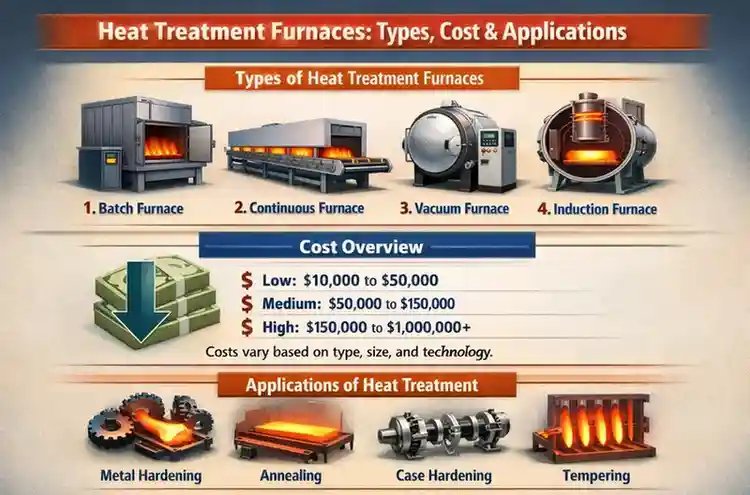
Heat Treatment Furnaces: Types, Cost & Applications
Heat Treatment Furnaces: Types, Cost & Applications
Heat treatment is a critical process in modern manufacturing that enhances the mechanical properties of metals, including strength, hardness, durability, and resistance to wear. At the heart of this process are heat treatment furnaces, essential industrial furnaces used across industries such as automotive, aerospace, oil & gas, and heavy engineering.
This comprehensive guide explores the different types of thermal treatment systems, their pricing, industrial applications, and how they contribute to production efficiency and ROI in 2026.
What Is a Heat Treatment Furnace?
A heat treatment furnace is a specialized piece of metal processing equipment designed to heat materials to specific temperatures under controlled conditions. This process alters the physical and chemical properties of metals to achieve desired characteristics.
Why Heat Treatment Is Important in Manufacturing
- Improves material strength and hardness
- Enhances wear resistance
- Increases fatigue life
- Optimizes mechanical performance
- Ensures product reliability
Types of Heat Treatment Furnaces
1. Annealing Furnaces
Used to soften metals and improve ductility by heating and slowly cooling materials.
2. Carburizing Furnaces
Introduce carbon into the surface layer of steel to improve hardness.
3. Vacuum Heat Treatment Furnaces
Operate in a vacuum environment to prevent oxidation and contamination.
4. Induction Heating Furnaces
Use electromagnetic induction for rapid and efficient heating.
5. Batch Furnaces
Process materials in batches, suitable for low to medium production volumes.
6. Continuous Furnaces
Designed for high-volume production with automated material handling.
Heat Treatment Furnace Price (2026)
The heat treatment furnace price depends on size, technology, automation level, and application requirements.
| Furnace Type | Price Range (USD) | Application |
|---|---|---|
| Batch Furnace | $20,000 - $100,000 | Small-scale operations |
| Continuous Furnace | $100,000 - $500,000+ | Mass production |
| Vacuum Furnace | $150,000 - $1,000,000+ | High-precision industries |
| Induction Furnace | $50,000 - $300,000 | Rapid heating processes |
Key Components of Heat Treatment Furnaces
- Heating elements
- Temperature control systems
- Insulation materials
- Atmosphere control systems
- Material handling systems
Applications of Heat Treatment Furnaces
Automotive Industry
Used for gears, shafts, and engine components to improve durability.
Aerospace Industry
Ensures high strength and reliability of critical components.
Oil & Gas Industry
Enhances corrosion resistance of drilling equipment.
Metal Fabrication
Improves machinability and structural integrity of metal parts.
Benefits of Modern Heat Treatment Furnaces
1. Improved Product Quality
Ensures consistent material properties and reduces defects.
2. Increased Production Efficiency
Automated systems reduce cycle times and improve throughput.
3. Energy Efficiency
Modern furnaces are designed for optimal energy utilization.
4. Reduced Operational Costs
Lower energy consumption and maintenance costs.
5. Enhanced Process Control
Advanced sensors and controls ensure precise temperature management.
Comparison of Furnace Types
| Parameter | Batch Furnace | Continuous Furnace | Vacuum Furnace |
|---|---|---|---|
| Production Volume | Low | High | Medium |
| Automation | Moderate | High | High |
| Precision | Moderate | High | Very High |
| Cost | Low | High | Very High |
Automation in Heat Treatment Systems
Modern industrial furnaces are integrated with automation technologies such as:
- Programmable logic controllers (PLC)
- IoT-based monitoring systems
- AI-driven process optimization
- Robotic material handling
Challenges in Heat Treatment Processes
- High initial investment
- Energy consumption
- Maintenance requirements
- Process complexity
ROI of Heat Treatment Furnaces
Investing in advanced thermal treatment systems provides significant returns through improved efficiency and product quality.
| Metric | Before Implementation | After Implementation |
|---|---|---|
| Production Output | 100 Units | 150 Units |
| Defect Rate | 10% | 3% |
| Energy Efficiency | 70% | 90% |
Future Trends in Heat Treatment Technology
- AI-based furnace optimization
- Energy-efficient heating technologies
- Integration with smart manufacturing systems
- Advanced material processing techniques
How to Choose the Right Heat Treatment Furnace
- Evaluate production volume
- Determine required temperature range
- Consider automation needs
- Analyze total cost of ownership
Expert Tips
- Invest in energy-efficient models
- Choose scalable systems for future growth
- Work with reliable suppliers
Conclusion
Heat treatment furnaces are essential for modern manufacturing, enabling industries to enhance material properties and achieve superior product quality. By investing in advanced industrial furnaces and metal processing equipment, businesses can improve efficiency, reduce costs, and gain a competitive edge.
As manufacturing technologies evolve, adopting innovative thermal treatment systems will be key to achieving long-term success and sustainability.
Ready to upgrade your heat treatment process? Choosing the right furnace can transform your production capabilities and maximize ROI.