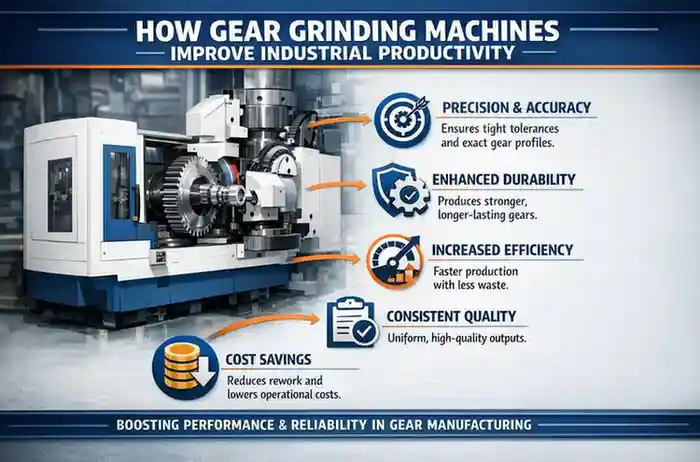
How Gear Grinding Machines Improve Industrial Productivity
How Gear Grinding Machines Improve Industrial Productivity
In today’s hyper-competitive global manufacturing environment, improving industrial productivity is no longer optional—it is essential. Manufacturers across automotive, aerospace, energy, and heavy engineering sectors are rapidly adopting gear grinding machines as a key solution to boost efficiency, reduce defects, and maximize return on investment (ROI).
This comprehensive guide explores how gear grinding productivity directly impacts modern factories, and why investing in advanced industrial automation machines is one of the smartest moves for long-term growth.
Understanding Gear Grinding in Modern Manufacturing
Gear grinding is a precision finishing process that uses abrasive wheels to refine gear teeth to extremely tight tolerances. Unlike traditional machining, grinding ensures:
- Superior surface finish
- Higher dimensional accuracy
- Improved load distribution
- Reduced noise and vibration
This level of precision is critical for industries where performance and durability are non-negotiable.
Why Industrial Productivity Matters More Than Ever
Industrial productivity is directly linked to profitability. Higher efficiency means lower costs, faster production cycles, and better product quality.
Modern factories are under pressure to:
- Reduce operational costs
- Increase output without increasing labor
- Maintain consistent quality
- Adopt factory optimization strategies
Key Ways Gear Grinding Machines Improve Productivity
1. Enhanced Precision Reduces Defects
One of the biggest contributors to productivity loss is defective products. Gear grinding machines achieve micron-level accuracy, significantly reducing rejection rates.
| Factor | Without Grinding | With Gear Grinding |
|---|---|---|
| Defect Rate | 8-12% | 2-4% |
| Surface Finish | Moderate | High Precision |
| Rework Required | High | Minimal |
Lower defects translate into reduced material waste and higher production efficiency.
2. Faster Production Cycles
Modern CNC machine benefits include automation and high-speed processing. Gear grinding machines can operate continuously with minimal downtime, significantly improving throughput.
- Automated workflows
- Reduced manual intervention
- Consistent production speed
3. Automation & Smart Manufacturing
Advanced gear grinding machines are integrated with Industry 4.0 automation technologies such as:
- IoT-enabled monitoring systems
- AI-driven process optimization
- Predictive maintenance
This level of automation reduces human error and ensures consistent output quality.
4. Reduced Operational Costs
Although the initial investment in gear grinding machines may be high, the long-term savings are substantial:
- Lower labor costs
- Reduced material waste
- Less machine downtime
| Cost Factor | Traditional Machining | Gear Grinding |
|---|---|---|
| Labor Cost | High | Reduced by 30-40% |
| Maintenance | Frequent | Predictive & Optimized |
| Energy Efficiency | Moderate | High |
5. Improved Product Quality
High-quality gears lead to better-performing end products. This is especially important in industries such as automotive and aerospace, where performance standards are extremely high.
- Smoother gear operation
- Longer lifespan
- Better customer satisfaction
6. Scalability for Mass Production
Gear grinding machines enable manufacturers to scale production without compromising quality. CNC systems allow for easy adjustments and repeatability.
Impact on Manufacturing Efficiency Tools
Gear grinding machines are a cornerstone of modern manufacturing efficiency tools. When integrated with other systems, they create a highly optimized production environment.
- ERP system integration
- Automated material handling
- Real-time production analytics
Factory Optimization Strategies Using Gear Grinding
To fully leverage the benefits of gear grinding machines, manufacturers should adopt comprehensive factory optimization strategies:
1. Workflow Automation
Streamline production processes to eliminate bottlenecks.
2. Data-Driven Decision Making
Use analytics to identify inefficiencies and improve performance.
3. Predictive Maintenance
Reduce downtime by addressing issues before they occur.
4. Skilled Workforce Training
Ensure operators are trained to handle advanced CNC systems.
Real-World ROI of Gear Grinding Machines
The return on investment for gear grinding machines is significant when implemented correctly.
| Metric | Before Implementation | After Implementation |
|---|---|---|
| Production Output | 100 Units/Day | 150 Units/Day |
| Defect Rate | 10% | 3% |
| Profit Margin | 15% | 25% |
This demonstrates how gear grinding machines directly contribute to profitability and efficiency.
Industries Benefiting from Gear Grinding Productivity
Automotive Industry
Used for high-performance transmission systems and electric vehicle components.
Aerospace Industry
Ensures precision in turbine engines and flight systems.
Energy Sector
Critical for wind turbine gearboxes and power generation.
Heavy Machinery
Improves durability and performance of construction equipment.
Future of Industrial Automation Machines
The future of industrial automation machines is driven by innovation and digital transformation.
- AI-powered machining systems
- Smart factories with IoT connectivity
- Advanced robotics integration
- Eco-friendly manufacturing solutions
Challenges and Considerations
While gear grinding machines offer numerous benefits, manufacturers must consider:
- High initial investment
- Training requirements
- Maintenance planning
Conclusion
Gear grinding machines are a powerful tool for improving industrial productivity in modern manufacturing. By reducing defects, increasing efficiency, and enabling automation, they provide a strong foundation for long-term growth and profitability.
Manufacturers who invest in advanced precision engineering solutions today will be better positioned to compete in the global market of tomorrow.
Ready to optimize your factory performance? Gear grinding machines could be the key to unlocking higher productivity, better quality, and increased ROI.