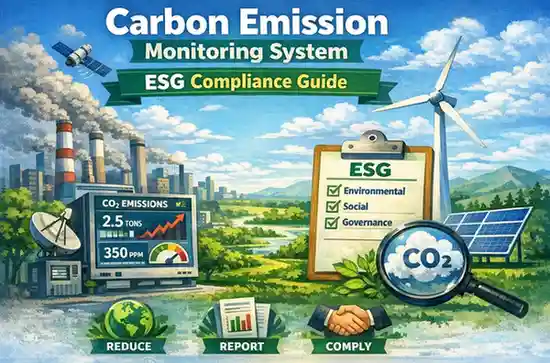
Carbon Emission Monitoring System: ESG Compliance Guide
Carbon Emission Monitoring System: ESG Compliance Guide
As global regulations tighten and sustainability becomes a core business priority, industries are under increasing pressure to monitor, report, and reduce carbon emissions. A carbon emission monitoring system plays a critical role in helping organizations achieve ESG compliance, improve environmental performance, and reduce operational risks.
This comprehensive guide explores carbon tracking systems, their benefits, costs, technologies, and how they enable industries to meet global sustainability standards while improving profitability.
What Is a Carbon Emission Monitoring System?
A carbon emission monitoring system is an advanced technology solution designed to measure, track, and report greenhouse gas (GHG) emissions from industrial processes. These systems provide real-time insights into emission levels, helping organizations comply with environmental regulations and sustainability goals.
Why ESG Compliance Matters in 2026
Environmental, Social, and Governance (ESG) compliance has become a key factor influencing investor decisions, regulatory approvals, and corporate reputation.
- Mandatory reporting regulations in Tier 1 countries
- Investor demand for sustainability transparency
- Carbon tax and emission penalties
- Corporate sustainability commitments
Key Components of Carbon Monitoring Systems
1. Emission Sensors
Measure gases such as CO2, NOx, and SO2 directly from industrial processes.
2. Data Acquisition Systems
Collect and process data from multiple monitoring points.
3. Cloud-Based Analytics
Provide real-time dashboards and reporting tools.
4. Compliance Reporting Software
Ensures accurate reporting for regulatory bodies.
Types of Carbon Emission Monitoring Systems
Continuous Emission Monitoring Systems (CEMS)
Provide real-time monitoring of emissions from industrial stacks.
Predictive Emission Monitoring Systems (PEMS)
Use AI models to estimate emissions based on operational data.
Portable Monitoring Systems
Used for temporary or mobile emission tracking.
Carbon Emission Monitoring System Cost (2026)
The cost of pollution monitoring equipment depends on system complexity, industry type, and compliance requirements.
| System Type | Price Range (USD) | Application |
|---|---|---|
| Portable Systems | $5,000 - $25,000 | Small industries |
| PEMS | $20,000 - $100,000 | Medium industries |
| CEMS | $50,000 - $300,000+ | Large industrial plants |
How Carbon Monitoring Systems Work
- Capture emissions data via sensors
- Transmit data to central systems
- Analyze emissions using AI algorithms
- Generate compliance reports
Benefits of Carbon Emission Monitoring Systems
1. Regulatory Compliance
Ensures adherence to global environmental standards.
2. Cost Reduction
Minimizes penalties and optimizes energy usage.
3. Improved Sustainability
Supports corporate ESG goals and carbon neutrality targets.
4. Data-Driven Decision Making
Provides actionable insights for emission reduction strategies.
5. Enhanced Brand Reputation
Demonstrates commitment to environmental responsibility.
ESG Compliance Frameworks Supported
- ISO 14001 Environmental Management
- GHG Protocol
- EU Emissions Trading System (EU ETS)
- SEC Climate Disclosure Rules
Carbon Reduction Metrics
| Metric | Before Implementation | After Implementation |
|---|---|---|
| Carbon Emissions | 100% | 70% |
| Energy Efficiency | 75% | 90% |
| Compliance Rate | Partial | Full |
Applications Across Industries
Manufacturing
Tracks emissions from production processes.
Oil & Gas
Monitors emissions from drilling and refining operations.
Power Plants
Ensures compliance with emission standards.
Chemical Industry
Controls hazardous gas emissions.
Integration with Smart Sustainability Systems
Modern sustainability tools integrate carbon monitoring with:
- IoT-enabled sensors
- AI-based emission analytics
- Cloud-based ESG reporting
- Digital twin technology
Challenges in Implementation
- High initial investment
- Complex integration
- Data accuracy requirements
- Maintenance and calibration
ROI of Carbon Monitoring Systems
Investing in carbon tracking systems delivers strong ROI through compliance, cost savings, and improved efficiency.
| Metric | Before | After |
|---|---|---|
| Penalty Costs | High | Reduced |
| Energy Costs | High | Optimized |
| ROI Period | - | 1-3 Years |
Future Trends in Carbon Monitoring
- AI-powered emission prediction
- Blockchain-based ESG reporting
- Smart grid integration
- Real-time global compliance tracking
How to Choose the Right System
- Evaluate emission sources
- Understand regulatory requirements
- Analyze scalability
- Compare cost vs ROI
Expert Tips
- Invest in scalable solutions
- Choose systems with real-time analytics
- Ensure compliance with global standards
Conclusion
Carbon emission monitoring systems are essential for achieving ESG compliance and sustainable industrial growth. By leveraging advanced pollution monitoring equipment and carbon tracking systems, businesses can reduce emissions, avoid penalties, and enhance operational efficiency.
As environmental regulations continue to evolve, investing in sustainability tools is no longer optional—it is a strategic necessity for long-term success.
Ready to achieve ESG compliance? Implementing a carbon emission monitoring system is the first step toward a cleaner, more efficient, and profitable future.