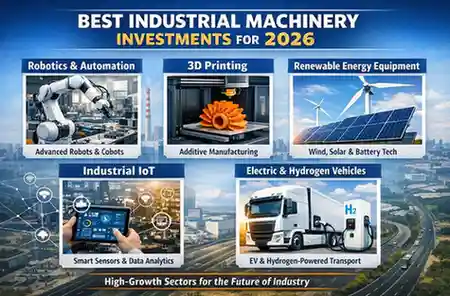
Best Industrial Machinery Investments for 2026
Best Industrial Machinery Investments for 2026
Investing in industrial machinery can yield significant returns when aligned with market trends, technological advancements, and global demand. The year 2026 presents unique opportunities for businesses to invest in high-profit industrial equipment that enhances efficiency, productivity, and overall ROI. This guide provides an in-depth look at the top industrial machinery investment options, cost-benefit analysis, and strategies to maximize returns.
1. Smart Manufacturing Equipment
Smart manufacturing equipment is the cornerstone of Industry 4.0. These machines leverage IoT, AI, and automation to optimize production, reduce operational costs, and minimize downtime.
- IoT-enabled monitoring for predictive maintenance
- AI-driven process optimization
- Integration with digital twins for virtual simulation
2. Energy-Efficient Industrial Machines
Energy-efficient machines not only reduce operational costs but also support sustainability initiatives. In Tier 1 markets, companies are willing to pay a premium for equipment that lowers energy consumption and carbon footprint.
3. Additive Manufacturing and 3D Printing Systems
3D printing and additive manufacturing systems are transforming production by enabling rapid prototyping, customization, and low-volume high-complexity part manufacturing. These systems offer high ROI through reduced inventory costs and faster time-to-market.
4. Automated Conveyor and Material Handling Systems
Automation in material handling, including conveyors, robotic arms, and automated guided vehicles, improves workflow efficiency and reduces labor costs, ensuring consistent production quality and faster throughput.
5. Industrial Inspection and QA Equipment
Machines like CMMs (Coordinate Measuring Machines) and spectrophotometers are essential for quality control in manufacturing. Investing in high-precision QA equipment minimizes defects, enhances product reliability, and reduces costly rework.
6. CNC and Advanced Machining Tools
Modern CNC machines and advanced machining tools are critical for precision manufacturing across aerospace, automotive, and engineering sectors. High-speed, multi-axis CNC machines reduce production time while maintaining accuracy.
7. Robotics and Collaborative Automation
Collaborative robots (cobots) work alongside human operators to improve efficiency and safety. Investment in flexible robotics allows factories to scale production dynamically while maintaining low labor costs.
Cost vs ROI Analysis
| Machine Type | Investment Cost | Expected ROI | Key Benefits |
|---|---|---|---|
| Smart Manufacturing Equipment | High (IoT & AI integration) | 12-24 months | Operational efficiency, predictive maintenance, reduced downtime |
| Energy-Efficient Machines | Moderate to High | 18-30 months | Lower energy costs, sustainability compliance, premium product appeal |
| 3D Printing Systems | Moderate | 12-18 months | Rapid prototyping, inventory reduction, customization capability |
| Automated Conveyor Systems | Moderate | 12-24 months | Labor cost reduction, faster throughput, improved safety |
| CNC & Advanced Machining Tools | High | 18-36 months | Precision manufacturing, reduced production time, higher quality output |
| Collaborative Robots (Cobots) | Moderate to High | 12-24 months | Flexible automation, improved safety, scalable operations |
Strategies to Maximize Returns
- Select machines that align with industry trends and market demand.
- Invest in energy-efficient and automated equipment to lower operational costs.
- Leverage analytics and IoT integration for predictive maintenance and workflow optimization.
- Train workforce to utilize smart machinery effectively.
- Continuously monitor ROI metrics to adjust investment strategy.
Global Demand and Market Trends
The industrial machinery market in 2026 is influenced by global trends, including:
- Rising demand for automation in Tier 1 and Tier 2 countries
- Focus on sustainability and energy efficiency
- Integration of AI and digital twin technologies
- Customized production solutions for specialized industries
Conclusion
Investing in industrial machinery in 2026 requires careful consideration of cost, ROI, and market trends. By prioritizing smart, energy-efficient, and automated equipment, manufacturers can maximize profitability, reduce operational expenses, and remain competitive in the global market. Strategic investment in high-demand machinery ensures long-term business growth and sustainable operations.